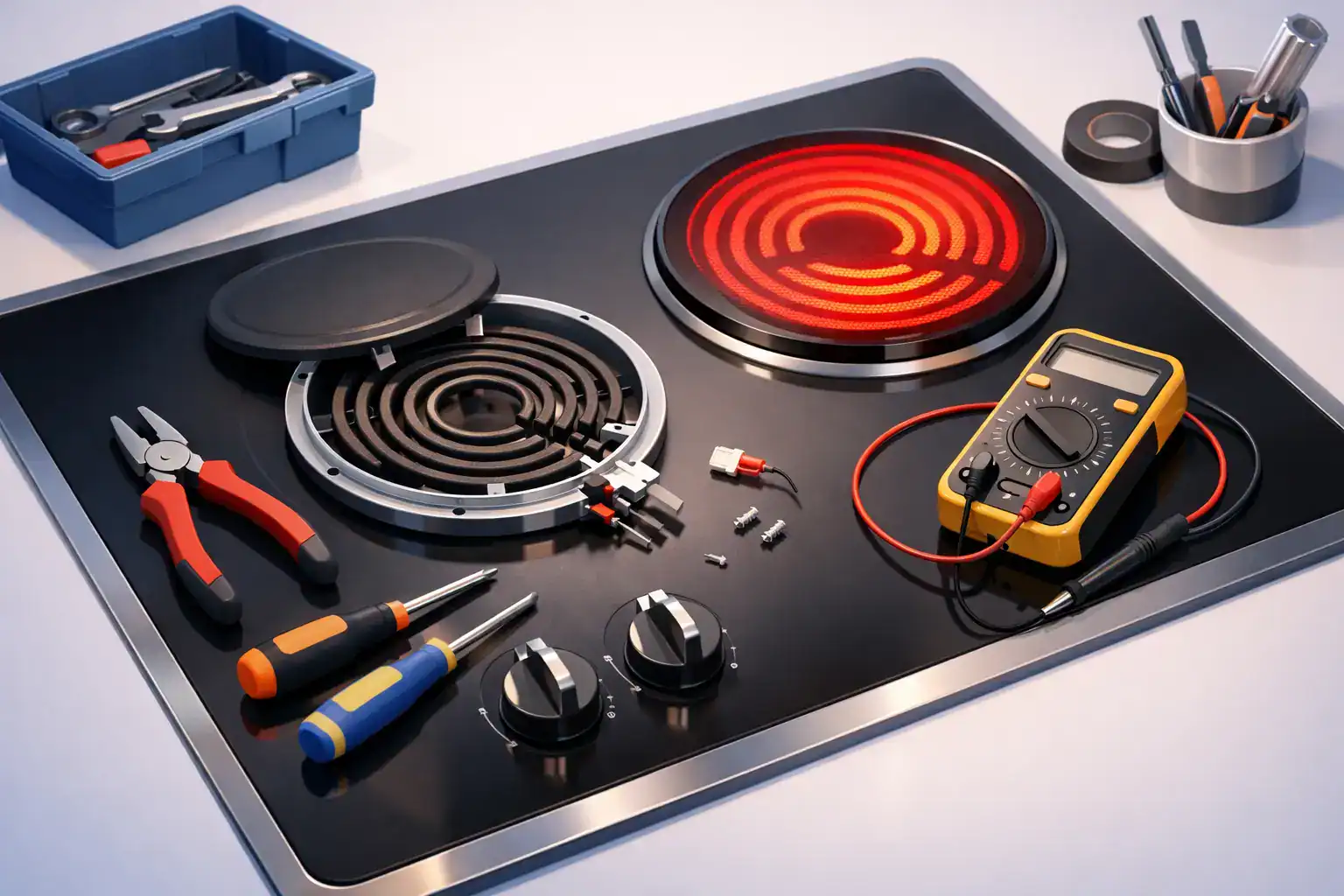
A range that quits in the middle of dinner creates an immediate problem. Whether one burner stays cold, the oven will not heat, or the display is blank, knowing how to troubleshoot electric range issues can help you rule out simple causes and make a safe decision about repair. Start slowly, avoid taking chances around high-voltage wiring, and remember that a range can look normal while still having an electrical fault.
Start With Safety and the Power Supply
Before moving cookware, checking components, or pulling the appliance away from the wall, turn the range off and let every surface cool completely. If you smell burning insulation, see smoke, notice sparking, or find a scorched outlet or cord, switch off the range breaker if it is safe to do so. Do not use the appliance again until a qualified technician has inspected it.
Electric ranges typically use a 240-volt circuit. That is substantially different from plugging in a small countertop appliance, and it is why internal electrical testing and wiring repairs are best left to a professional. Homeowners can still perform a few useful checks without opening panels or touching wires.
First, look at the home electrical panel. A range usually has a double-pole breaker. One side can trip while the other appears to remain on, leaving the clock, display, or oven light working even though the heating elements cannot receive full power. Turn the range breaker fully to OFF, then back to ON once. If it trips again, leave it off and schedule service. Repeated trips may point to a shorted element, damaged wiring, or another issue that needs diagnosis.
Also check that the range is firmly plugged into its outlet if the plug is accessible. Do not force a loose plug, use an extension cord, or remove the outlet cover. A loose or heat-damaged connection needs professional attention.
How to Troubleshoot Electric Range Burner Problems
A burner that will not heat is one of the most common range complaints. The pattern of the failure tells you a great deal. If only one surface burner is affected, the problem is often limited to that burner, its receptacle, its switch, or the control board. If several burners stop heating at once, suspect the power supply or a broader control issue.
One coil burner stays cold
For a traditional coil-top range, allow the burner to cool, then remove and reseat the coil in its receptacle. The prongs should sit securely and straight. Look for obvious damage such as blistering, cracks, burned spots, or a warped coil. If you have another same-size burner that is known to work, you can swap it after the power is off and the unit is cool.
If the questionable coil works in the other location, the issue may be the original receptacle or burner switch. If the working coil does not heat in the original location either, do not keep experimenting. The receptacle or wiring may be damaged and should be repaired before the range is used.
A smooth-top element will not heat
On a glass-top range, the element is located under the cooking surface, so there is no coil to reseat or swap. Confirm that the correct control is selected and that the burner is not set to a low setting by mistake. If the indicator light comes on but the surface stays cold, the element, infinite switch, temperature sensor, or electronic control may have failed.
Do not lift the glass top or try to access the element from underneath unless you are trained for appliance repair. Glass cooktops are easy to damage, and electrical connections below them carry significant risk.
The burner gets too hot or will not turn off
A burner that stays on high, heats when set to low, or continues heating after the control is turned off should be treated as urgent. Turn the control off, then switch off the range breaker. The cause can be a failed surface-element switch or a defective electronic control. Until it is repaired, the range presents a burn and fire risk.
When the Oven Will Not Heat
An oven problem can look different depending on whether it is failing in Bake, Broil, or both. On most electric ranges, the bake element is along the oven floor and the broil element is at the top. Some models hide the bake element beneath the oven floor, so a missing visible element does not mean your range does not have one.
Set the oven to Bake and give it several minutes. It is normal for heating elements to cycle on and off during operation, but the oven should begin warming and the interior should not remain completely cold. Check the display for an error code, a locked-control message, or a timer setting that may be preventing normal operation. If your model has a Sabbath mode or delayed start feature, review the owner’s manual for how to exit it.
With the power off and the oven cool, inspect visible elements for breaks, bubbling, scorch marks, or a section that has separated. A damaged element is a strong sign that replacement is needed. Do not continue using an element that sparks, glows unevenly, or has obvious damage.
If Bake does not work but Broil does, a failed bake element or bake circuit is likely. If neither function heats, the cause may be a tripped breaker, failed temperature sensor, control board, wiring problem, or loss of one side of the 240-volt supply. This is where professional diagnosis can prevent the expense of replacing a part that was not actually the problem.
Temperature Problems Need a Little Patience
An oven that heats but burns food or takes far too long may be out of calibration, have a weak element, or have a sensor or control problem. Before assuming the range is failing, test it with an oven thermometer placed near the center of the middle rack. Preheat the oven to 350 degrees and allow it to cycle for at least 20 to 30 minutes after it signals that preheating is complete.
A brief high or low reading does not always mean there is a problem. Oven temperatures naturally rise and fall as the appliance cycles. What matters is the average temperature over time. If the average is consistently far from the set temperature, check your owner’s manual for a user calibration feature. Some models allow modest adjustment through the control panel.
Calibration is not the right answer for every situation. If the temperature varies dramatically, food cooks unevenly, the oven takes an unusually long time to preheat, or an error code appears, an underlying part may be failing. Adjusting the calibration could hide the symptom without correcting the cause.
Check the Controls Before Assuming the Worst
Modern ranges rely on touch pads, electronic displays, sensors, and control boards. A locked control panel, timer setting, power interruption, or incorrect cooking mode can resemble a major failure. Confirm that the clock is set, the controls are unlocked, and the correct mode is selected. For example, convection bake and regular bake may heat differently, while a delayed start can keep the oven from turning on when expected.
If the display is blank, check the breaker first. If power has been restored but the display remains blank, do not remove the rear panel or attempt to replace a fuse inside the range. The issue could involve the terminal block, control board, wiring, or incoming power. Those repairs require safe voltage testing and the correct replacement parts.
Know When to Stop Troubleshooting
A little observation can save time, but there is a clear line between basic troubleshooting and repair work. Turn off the range and call for service if you notice burning smells, electrical arcing, a breaker that will not stay on, melted components, a burner that cannot be controlled, or an oven that fails after basic checks.
It is also wise to schedule service when the range has intermittent problems. A burner that works only sometimes or an oven that randomly loses heat may have a loose connection or a control issue that worsens with use. Waiting can turn a manageable repair into a damaged receptacle, wiring problem, or ruined meal at the worst possible time.
For homeowners in Edmond, Oklahoma City, and nearby communities, Don Fuller’s Appliance Repair can diagnose electric range problems with the care, clear communication, and dependable service your kitchen routine deserves. A quick professional inspection can bring back the confidence that dinner will be ready when your household is counting on it.